

Take Heart…Gen Z Girls are Doing Research to Save Your Life
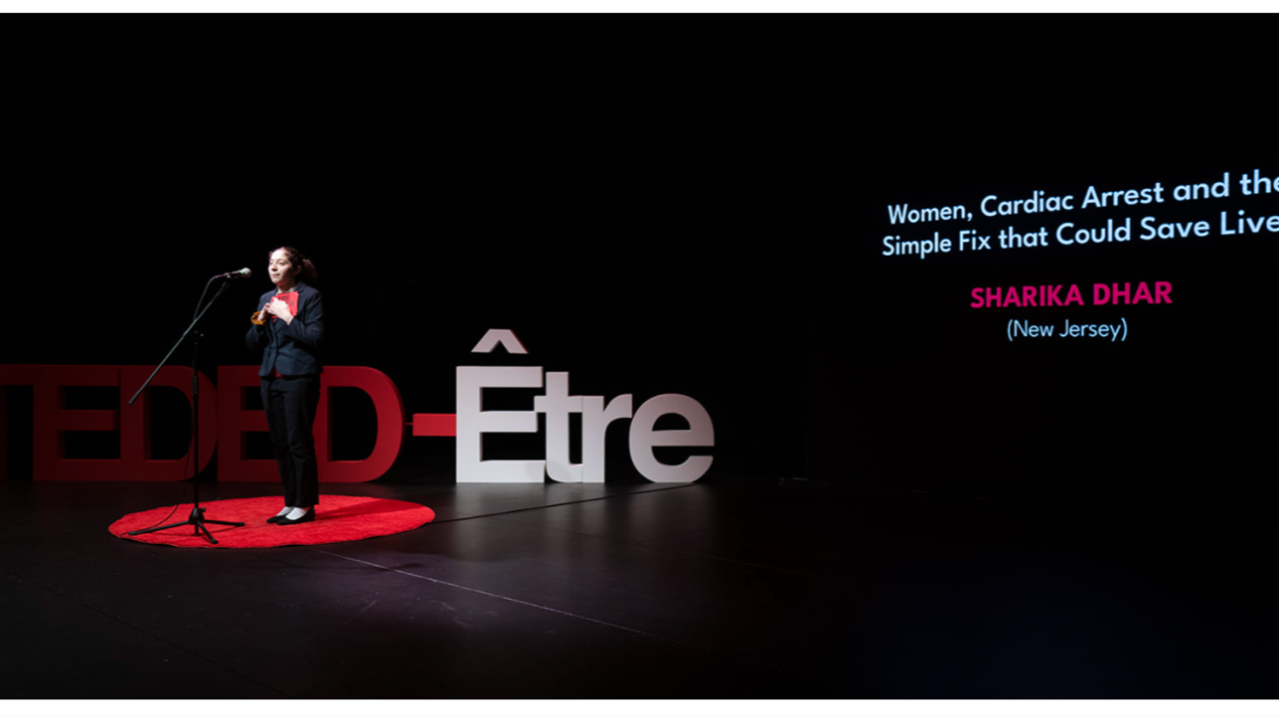
Photos via Erin Borzellino | Être
When I get emails from Gen Z girls seeking to change the world, it makes my entire week. My month, even.
So imagine my delight when just before Valentine's Day and in the midst of American Heart Month I received the following email:
"As the new year dawns upon us, there's been important updates to CPR guidelines taking effect in 2026. I'm interested in writing about these guidelines to spread awareness to first responders, and I was wondering if Être would be able to help publish this article in a newsletter?" - Sharika Dhar, Être TED-Ed speaker
Oh, one hundred percent - yes.
Remembering Sharika's extraordinary TED-Ed Talk in Season 5 entitled Women, Cardiac Arrest and the Simple Fix that Could Save Lives, I knew that any further research this high schooler was doing on the topic would have impact. I couldn't wait to share her work.
We reconnected with the following quick interview and her research is happily reposted below. I loved this exchange so much that it sparked a new feature of The Epic Mentor Newsletter - spotlighting thought leadership from Gen Z across the powerful network of LinkedIn. After crossing our 200th edition this month, this feels like the perfect way to celebrate!
And now, please meet Sharika Dhar:

Ê: I'm so excited to reconnect here! What first drew your interest to CPR and what inspired you to devote your 2025 TED-Ed talk to the subject?
SD: My first interest in CPR was in the classroom! I took a CPR certification class twice last year, and with both of those experiences, I noticed how techniques and strategies were constantly shifting and adapting to better enhance response time. Practicing compressions, I learned how CPR is far more than a skill; in fact, it bridges the ordinary with something truly life-saving. My 2025 TED-Ed talk was inspired by the teamwork aspect as well as the pattern I was observing in training: most of the mannequins were male. Seeing how people step in together to save a life, I was inspired to think beyond the classroom and consider how to make CPR more inclusive for all.
Ê: Your inspo is contagious! Okay, what is 1 thing you want everyone to know about CPR and the significance of these new changes?
SD: Action, even if not perfect, can save lives. The good part about the new guidelines is that they emphasize effective response time, especially catered to bystanders. These new changes reduce hesitation, encouraging more to step in during emergencies. The willingness to step in is what makes all the difference!
With that willingness to make a difference in the middle of American Heart Month, I'm deeply proud to feature Sharika's new article. Feel free to share and repost with generous hearts...
New Year Brings New CPR Changes - by Sharika Dhar
As the new year just began, emergency care and response entered a new phase that could have an impact on the efficiency of saving a life during cardiac emergencies. This is because as of early 2026, the American Heart Association has implemented its 2025 Guidelines for Cardiopulmonary Resuscitation (CPR) and Emergency Cardiovascular Care (ECC), which is going to be the biggest change since 2020. This is based on recent scientific discoveries and is supposed to bring the much-needed advancements in CPR training that are simple, effective, and can be understood and performed by people of all age groups.
The Research
Cardiac arrest remains an issue of concern in the U.S., as annually about 350,000 out-of-hospital cardiac arrests are documented, and in almost 90% of these cases, death occurs without the chance for life-saving procedures. The likelihood of survival from cardiac arrest declines with each passing minute without intervention. In fact, research suggests that if CPR is performed within the first 2 minutes, the odds of survival can be doubled or even tripled. Yet fewer than 50% of cardiac arrest victims receive CPR from a bystander before EMS arrives. These figures are some of the major reasons that call for the 2026 modifications.
Major AHA CPR Changes in 2026
The Unified Chain of Survival is among the significant changes, bringing together the separate chains of survival for adults, children, and infants into a single picture. The reasoning for this is that early detection of cardiac arrest will result in high-quality compressions at a high rate, access to a defibrillator, and coordinated care, all of which are life and death situations.
Improved Choking Response
The revised foreign body airway obstruction (FBAO, or choking) guidelines have specific steps for children and adults:
For infants, the revised guidelines recommend alternating five back blows with five chest thrusts with the heel of one hand, rather than abdominal thrusts, due to possible harm to the infant.
For children and adults, five back blows followed by five abdominal thrusts are recommended until the object is removed or the person is unconscious.
The basis for changing the choking response is to emphasize safety and effectiveness according to scientific research, which may show that previous methods are either ineffective or even more harmful to individuals within certain age groups.
Updated CPR Techniques
Infants: The technique of encircling hands with two thumbs or the technique with the heel of one hand is advocated for performing chest compressions, while the two-finger technique is omitted because of the difficulty of reaching the required depths.
Adults/Children: The guidelines emphasize the necessity of ensuring that the chest rises during the breaths. The guidelines also state that interruptions to the chest compressions should be minimized, with interruptions of less than 10 seconds, and the head tilt/chin lift is acceptable, with the jaw thrust technique for trauma cases.
Language for Clarity
The AHA has also changed the language of certain words to ensure ease of training. “Bystander” becomes “lay rescuer” to encourage all people on the scene to assist the victim. “Rescue breaths” is also made easier to understand by changing it to “breath.” “Ventilations” is reserved for use when an advanced airway is present, marking the distinction between the two types of rescue breathing.
Instructor Transition Deadline
To ensure that the training provided is based on the latest scientific discoveries, the AHA instructors are required to update all the CPR training resources by February 28, 2026. This will ensure that after the deadline, only updated material is used for the certification and public classes, an important step in the distribution of knowledge.
What This Means for Our Community
Changes in guidelines are important to keep up to date on how to save lives. According to the latest statistics, only about 41.7% of people who have cardiac arrest receive CPR from a bystander before the arrival of the EMS, but the quick provision of CPR results shows a great improvement in the outcomes of survival and brain health. For instance, if a child was a patient and their heart had not stopped for more than five minutes, the survival rate could be almost doubled.
The new guidelines set by the AHA and other international organizations take the initiative to empower ordinary individuals by making age-specific guidelines more accessible.
*****
And that, as Sharika noted at the top of our conversation, can be life-saving. In her words, "[t]he willingness to step in is what makes all the difference!"
In CPR, as in most things, it is our collective courage and willingness to be involved that changes lives. I couldn't be prouder to spotlight Sharika's words...stay tuned for more of-the-moment features from the next generation of lifesavers and change-makers.
Looking forward with a full heart,
Illana

ÊXTRAS: Three more ways to expand our knowledge during American Heart Month you won't want to miss: find a CPR course near you, learn to conduct CPR training on your own, and (my favorite) this AHA Spotify playlist of songs between 100 - 120 beats per minute - the rate at which you should perform compressions when administering CPR.